

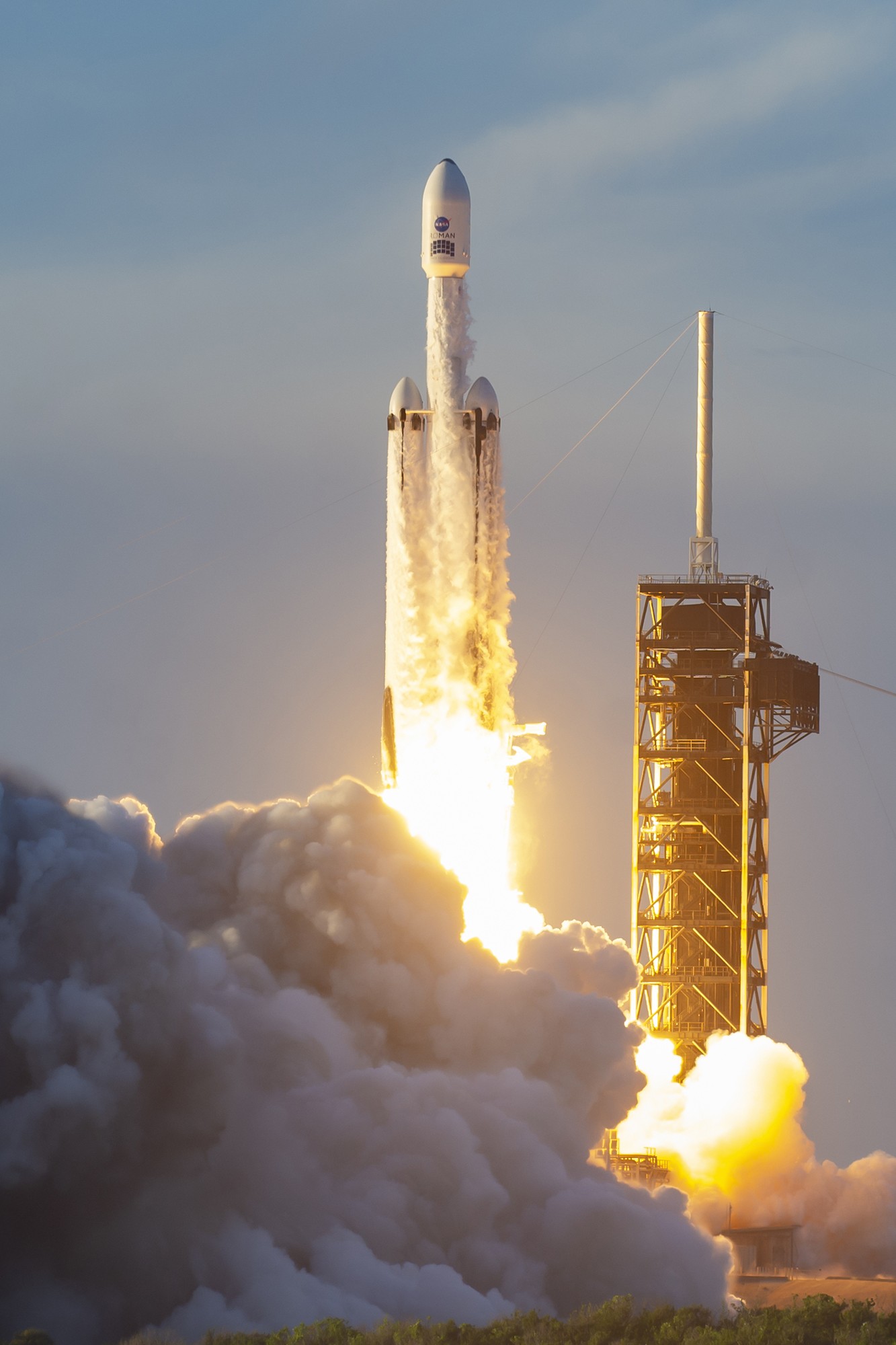
NASA’s Nancy Grace Roman Space Telescope launched on 30 August 2026 from Kennedy Space Center in Florida, lifting off atop a SpaceX Falcon Heavy rocket. The observatory is now travelling toward the Sun-Earth L2 Lagrange point, around 1.5 million kilometres from Earth, where it is expected to operate alongside the James Webb Space Telescope in a stable position shielded from the Sun’s glare, according to NASA.
A Much Wider Field of View
Roman carries a primary mirror the same size as Hubble’s, but NASA says a more curved mirror shape, a closer secondary mirror and a larger camera give it a field of view around 100 times larger than Hubble’s. That wide-field design is intended to let astronomers capture far more of the sky in a single exposure than earlier space telescopes, producing panoramic images rather than Hubble’s narrower, more detailed snapshots.
Dark Energy, Supernovae and New Worlds
According to NASA, Roman’s core science objectives include observing large numbers of supernovae to refine measurements of how the universe’s expansion has changed over time, and searching for planets orbiting distant stars through a technique called gravitational microlensing. Its broad sky coverage is also expected to substantially expand the catalogue of known exoplanets, complementing the more detailed but narrower observations made by Webb.
Why It Matters
Space telescopes such as Hubble and Webb have transformed scientific understanding of the universe largely one narrow field of view at a time. Roman’s far wider lens is designed to do similar work at much greater scale, giving researchers a statistically larger sample of galaxies, stars and planetary systems with which to study dark energy and planet formation. A successful mission would mark one of the most significant additions to NASA’s space observatory fleet in over a decade, and its early performance in the weeks ahead will be closely watched by astronomers worldwide.



Leave a Reply