

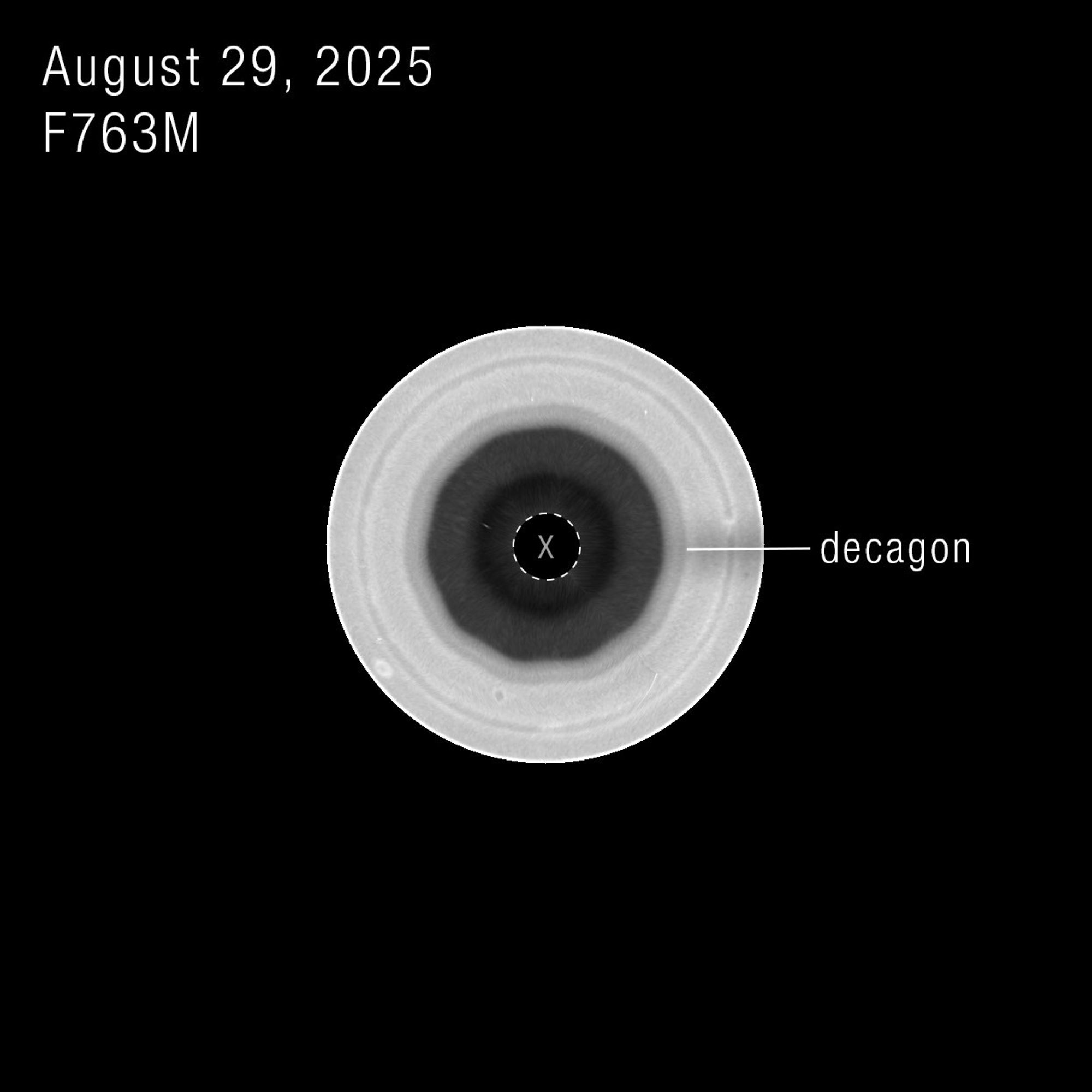
An international team of astronomers has confirmed the first detection of a ten-sided atmospheric wave, or decagon, encircling Saturn’s south pole, using observations from NASA’s Hubble Space Telescope. The findings, led by Agustin Sanchez-Lavega of the University of the Basque Country, were published on 2 September 2026 in the journal Science Advances, according to the Space Telescope Science Institute.
A Southern Counterpart to a Famous Feature
Saturn has long been known for the hexagon, a six-sided jet stream pattern that has persisted around its north pole for decades. Researchers say the newly identified decagon marks the first time a large, regular-sided polygon jet pattern has been observed in Saturn’s southern hemisphere, and it appears to be strengthening in observations taken since it was first faintly detected in 2023. Unlike the northern hexagon, whose origin scientists still debate, the decagon’s comparatively recent and well-documented emergence gives researchers a rare, near-complete observational record of a polygon jet stream forming from scratch.
Watching a Feature Emerge in Real Time
Saturn’s southern hemisphere fell out of view from Earth in 2012 due to the planet’s axial tilt and only became observable again in 2023, when Hubble imagery showed a faint ten-vertex polygon near 63 degrees south latitude. Scientists say continued monitoring in the years since suggests the decagon has been growing more defined, giving them an unusual opportunity to track the formation of a major atmospheric structure as it develops rather than studying one that has already stabilised.
Why It Matters
The discovery reinforces that gas giants like Saturn are dynamic worlds whose atmospheres continue to change on observable timescales, rather than fixed, unchanging bodies. Researchers hope continued observation of the decagon will help explain why such regular polygon-shaped jet streams form at all, and whether the feature will persist for decades the way Saturn’s northern hexagon has. Because Hubble remains one of the few instruments capable of resolving this level of detail on Saturn from Earth orbit, astronomers say sustained telescope time will be needed to track how the decagon evolves in the years ahead.



Leave a Reply