

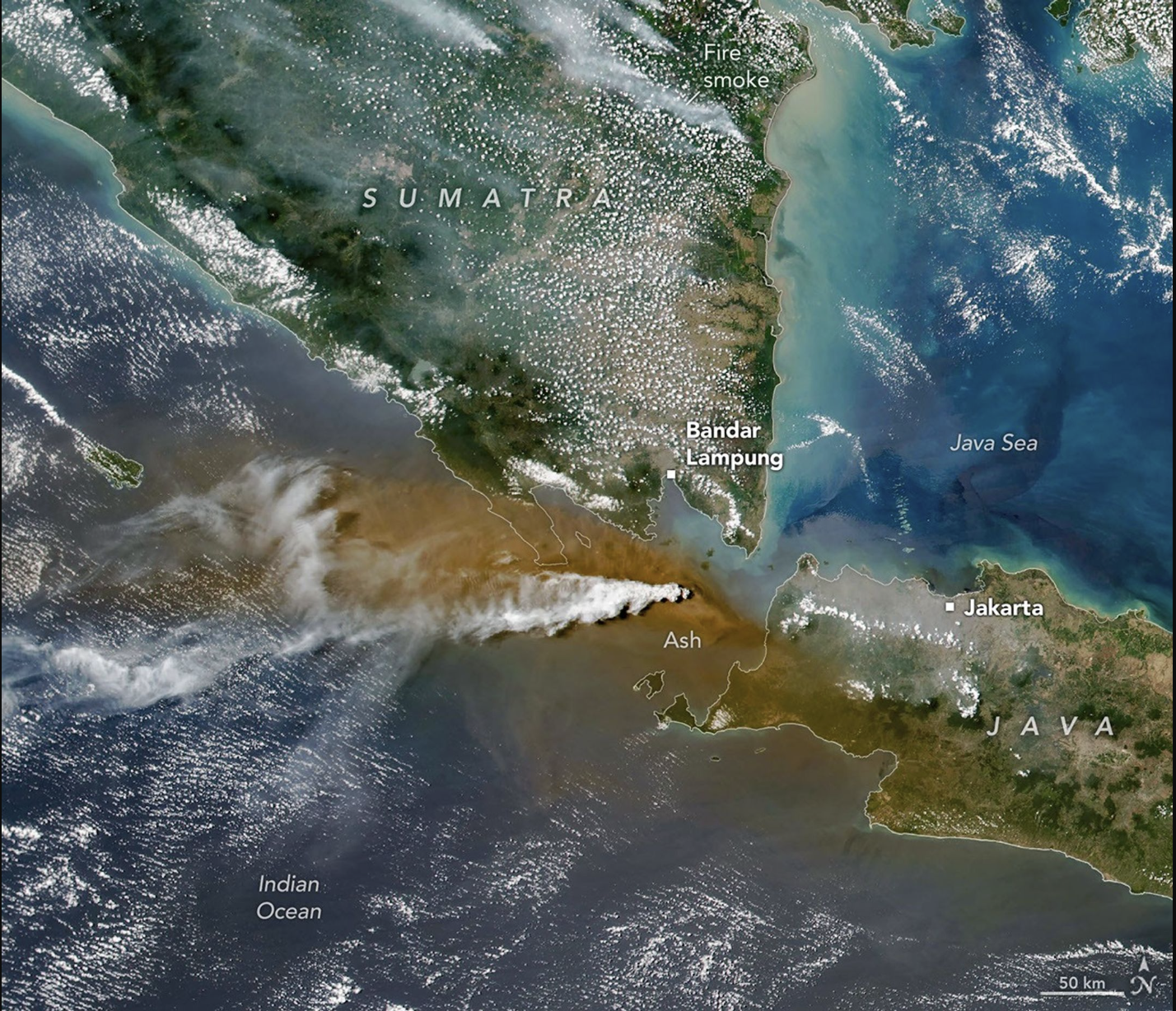
Indonesia’s Anak Krakatau volcano entered an active eruptive phase late on 4 September 2026, producing lava fountains, loud booming sounds and ash plumes that reached roughly 50,000 feet, according to reports citing Indonesian volcanic monitoring. Satellite imagery from NASA’s Earth Observatory captured the resulting ash cloud drifting across the Sunda Strait toward Sumatra and Java in the days that followed.
No Evacuation, But Wide Disruption
Authorities did not issue a formal evacuation order for nearby coastal communities, though a three-kilometre exclusion zone was maintained around the active crater and coastal evacuation routes were kept ready as a precaution against potential tsunami activity, a threat Anak Krakatau has posed before. Even without evacuations, ashfall spread across parts of western Indonesia, reaching populated areas east of the volcano including sections of Jakarta and West Java, affecting schools, fishing activity and daily life.
Impact on Air Travel
More than 300,000 airline passengers were affected as ash in the atmosphere forced the cancellation of flights across the region, according to reporting on the eruption’s aftermath. Volcanic ash poses a serious hazard to jet engines, and airlines routinely cancel or reroute flights when plumes threaten flight paths, a precaution that produced significant knock-on delays at airports serving Sumatra, Java and beyond, including some of the busiest air corridors in South-East Asia around Jakarta, with several international carriers issuing advisories for travellers passing through the region.
Why It Matters
Anak Krakatau, the volcanic island that emerged from the site of the catastrophic 1883 Krakatoa eruption, has a history of sudden activity, including a 2018 eruption and flank collapse that triggered a tsunami killing hundreds of people without any warning. The scale of aviation disruption this time, despite no confirmed casualties, illustrates how a single active volcano near one of the world’s busiest air corridors can ripple into travel and logistics disruption far beyond the immediate danger zone.



Leave a Reply