

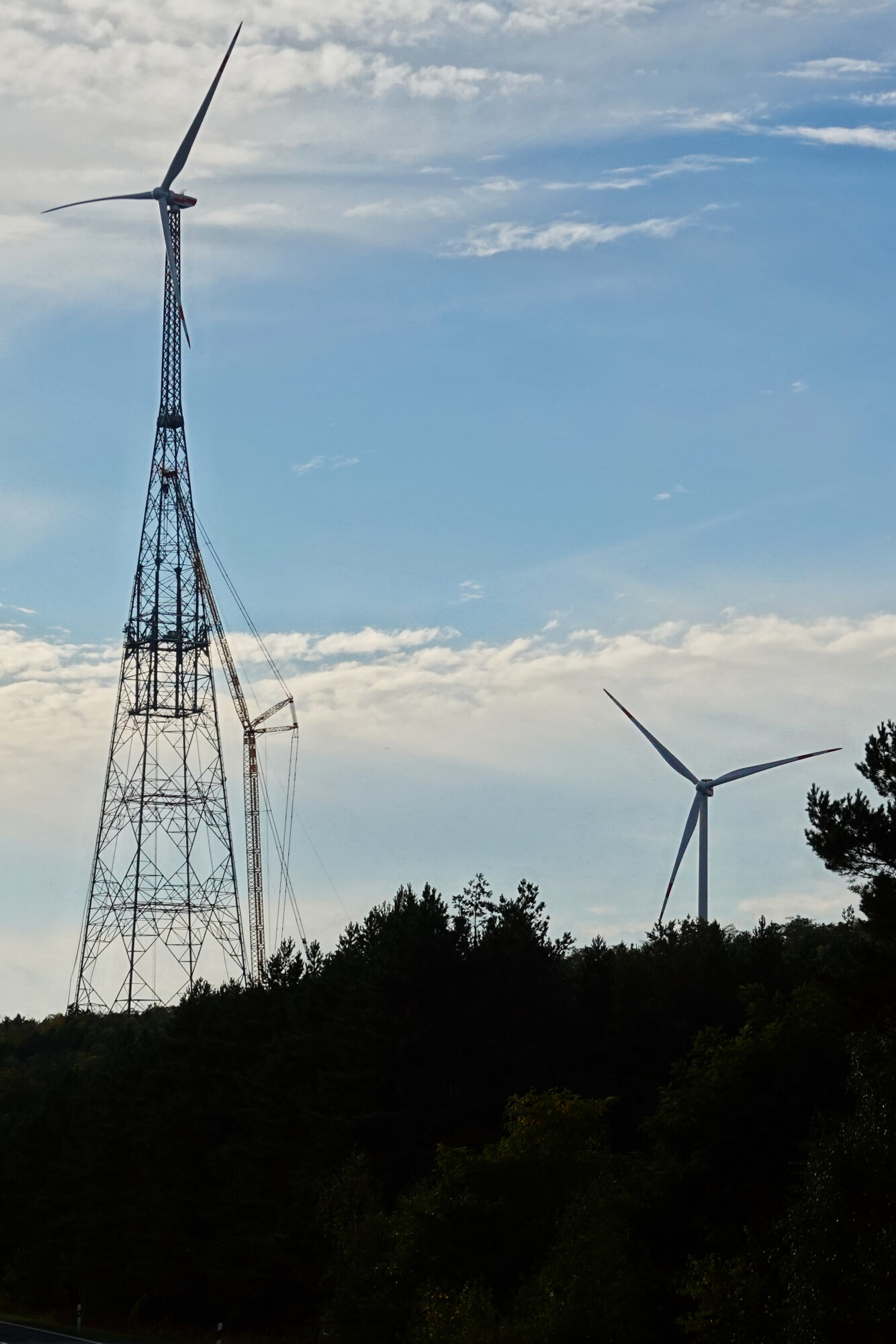
A wind turbine in Schipkau, in the Lusatia region of Brandenburg, eastern Germany, has reached its full height of 365 metres, according to its developer, Gicon, as reported by Euronews on 30 September 2026. The company and project backers describe it as the tallest wind turbine in the world, a claim made by the developer rather than independently verified here.
How It Was Built
The structure stands about as tall as a 100-storey building and is three metres shorter than Berlin’s TV Tower, Euronews reported. It was built on behalf of SPRIND, the Federal Agency for Leap Innovations, with the project commissioned through the firm beventum. Construction took about two years. Because conventional cranes cannot reach such heights, a patented telescopic device was used to raise the structure in stages beyond 150 metres, the report said.
The concept rests on the idea that winds at greater altitude are stronger and steadier. According to Euronews, Gicon hopes for an annual electricity yield of 30 to 33 gigawatt hours and production costs of less than five cents per kilowatt hour. The report says that yield is 220 per cent more than conventional turbines nearby and could supply about 7,500 four-person households. Grid connection is expected in November 2026. These numbers are projections, not measured results.
A Coal Region Looks Ahead
Lusatia has historically depended on coal. German Environment Minister Carsten Schneider was quoted as saying the project would help the country become independent of oil and gas from other regions of the world. Gicon chief executive Jochen Grossmann said safety and quality were the absolute priority in what he called a globally unique project. Plans reportedly include a hybrid power facility with wind at two heights and ground-level solar arrays.
Why It Matters
Wind power is limited by where the best sites are, and taller towers could unlock energy at locations that today yield modest returns. If the projections hold, high-altitude turbines might help countries with limited land or weaker surface winds. But a single prototype does not prove that the design can be built cheaply, maintained reliably or repeated at scale. The coming months of operation will show whether the measured output matches the forecasts, and whether a former coal region can become a testing ground for a new generation of renewable technology.



Leave a Reply