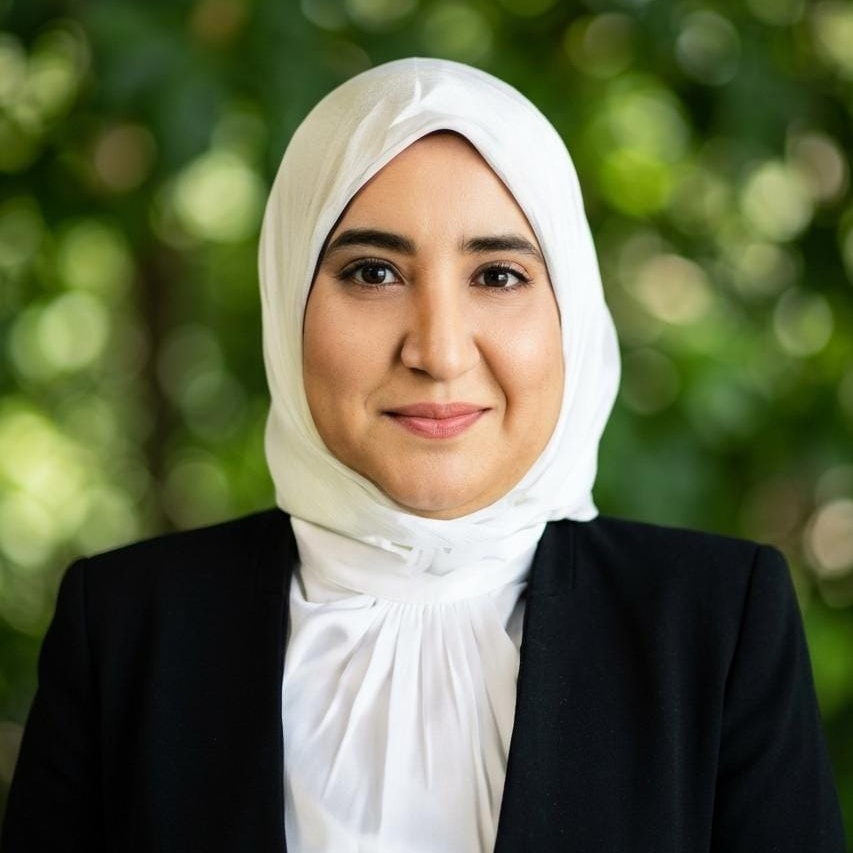
Asmaa Elzieny is an Egyptian Islamic scholar, linguist, and peacebuilder expert working at the intersection of religion, intercultural studies, gender, and international cooperation. She holds a Ph.D. with First-Class Honors in Linguistics from Al-Azhar University, where her research examined cultural pluralism in Feminine leadership discourse from a Socio-Cognitive perspective She serves as an official of foreign relations and international cooperation at Al-Azhar’s Supreme Council, a lecturer at the Faculty of Law and Sharia English; a lecturer at the Egyptian Police Academy, and the founder of the Raidat Initiative for Peacebuilding Sustainable Security (RIPSS). A Senior Fellow at the Global Peace Institute (UK) and Gingko Interfaith Fellow, she has lectured across Egypt, Indonesia, India, Uzbekistan, and Pakistan and attended a number of international forums, including the African Union’s High-Level Forum on Women, Peace, and Security. She is a published researcher, peer reviewer, and television commentator on interfaith politics.
True leadership is not about occupying space but creating it for others. As a woman working within Islamic scholarship, I’ve learned that authority earned through knowledge and service outlasts authority claimed through position.
Your path runs from the classroom to the African Union’s high-level forums. How did linguistics lead you into peacebuilding diplomacy?
My path began in the classroom, teaching English and training teachers across Al-Azhar’s institutes from 2006 to 2018. A Ph.D. examining how women political leaders are discursively constructed sharpened my interest in language, power, and legitimacy. That grounding led me to found the Raidat Initiative for Peacebuilding Sustainable Security, lecture on intercultural studies for Indonesia’s Ulama Education Program (Master’s and PhD), teach at the Faculty of Law and Sharia English Section and at the Egyptian Police Academy. Fellowships with the Global Peace Institute and Gingko Interfaith Fellowship connected me to global peacebuilding networks, while invitations to speak at the African Union, in Uzbekistan, Tunisia, Singapore, Pakistan, India, and Switzerland extended my work internationally. Alongside this, continuous academic publishing and peer review kept my work rigorous. Each step reflects one conviction: that Al-Azhar’s tradition of religious scholarship, carried by women, is an underused force for peace.
What impact has the Raidat Initiative had on how women’s leadership is understood within Islamic scholarship?
Through the Raidat Initiative, I work to expand women’s roles in peacebuilding and sustainable security, translating the Women, Peace, and Security agenda into action grounded in Egypt’s context. As a lecturer for Al-Azhar’s students and Indonesian ulama, I help shape how the next generation of religious scholars understands pluralism and coexistence. My publications on Islamic linguistics and women’s leadership discourse challenge reductive narratives about Muslim women’s agency, while my Egyptian television appearances on Muslim-Christian relations and national unity bring these ideas to a broad public. Representing as Azhari at the African Union, in Tunisia, Uzbekistan, Singapore, and Switzerland has let me carry Egypt’s model of religious moderation into global peace and security conversations.
Looking back, what achievement means the most to you?
Founding the Raidat Initiative for Peacebuilding Sustainable Security stands out as my most meaningful achievement, building, from within Al-Azhar’s own tradition, a platform dedicated to women’s leadership in peace and security. Being invited to speak at the African Union’s 6th High-Level Forum on Women, Peace, and Security in Tunisia (2025) validated years of connecting religious scholarship to global policy. Earning a Senior Fellowship at the Global Peace Institute and a Gingko Interfaith Fellowship were competitive international recognitions of that work. Completing a Ph.D. with First-Class Honors while teaching, publishing, and traveling for international engagements gave me the credibility to speak with authority across both religious and academic spaces.
What makes your voice distinct in rooms where religious scholarship and international policy rarely meet?
My work sits at a rare intersection: rigorous academic linguistics, grounded Islamic scholarship from within Al-Azhar, and hands-on peacebuilding through the Raidat Initiative. Few voices bridge religious authority and international peace and security policy the way I aim to, bringing a credentialed Azhari perspective into rooms, from the African Union to Geneva, where it is often absent, and using that credibility to expand space for women’s religious and diplomatic leadership specifically.
What advice would you give women hoping to build authority the way you have?
Root your leadership in genuine expertise, not just visibility; mine was built through years of teaching, research, and peer-reviewed publishing before I stepped onto international platforms. Don’t wait for permission to lead; if the space you need doesn’t exist, build it, as I did with the Raidat Initiative. Seek out fellowships and international networks deliberately; they open doors individual effort alone cannot. Work across disciplines and cultures rather than staying in one lane. My most valuable insights came from combining linguistics, religion, and diplomacy. And let your work reach audiences in different registers, academic papers, television commentary, and classroom teaching, because impact multiplies when the same message reaches different people.