

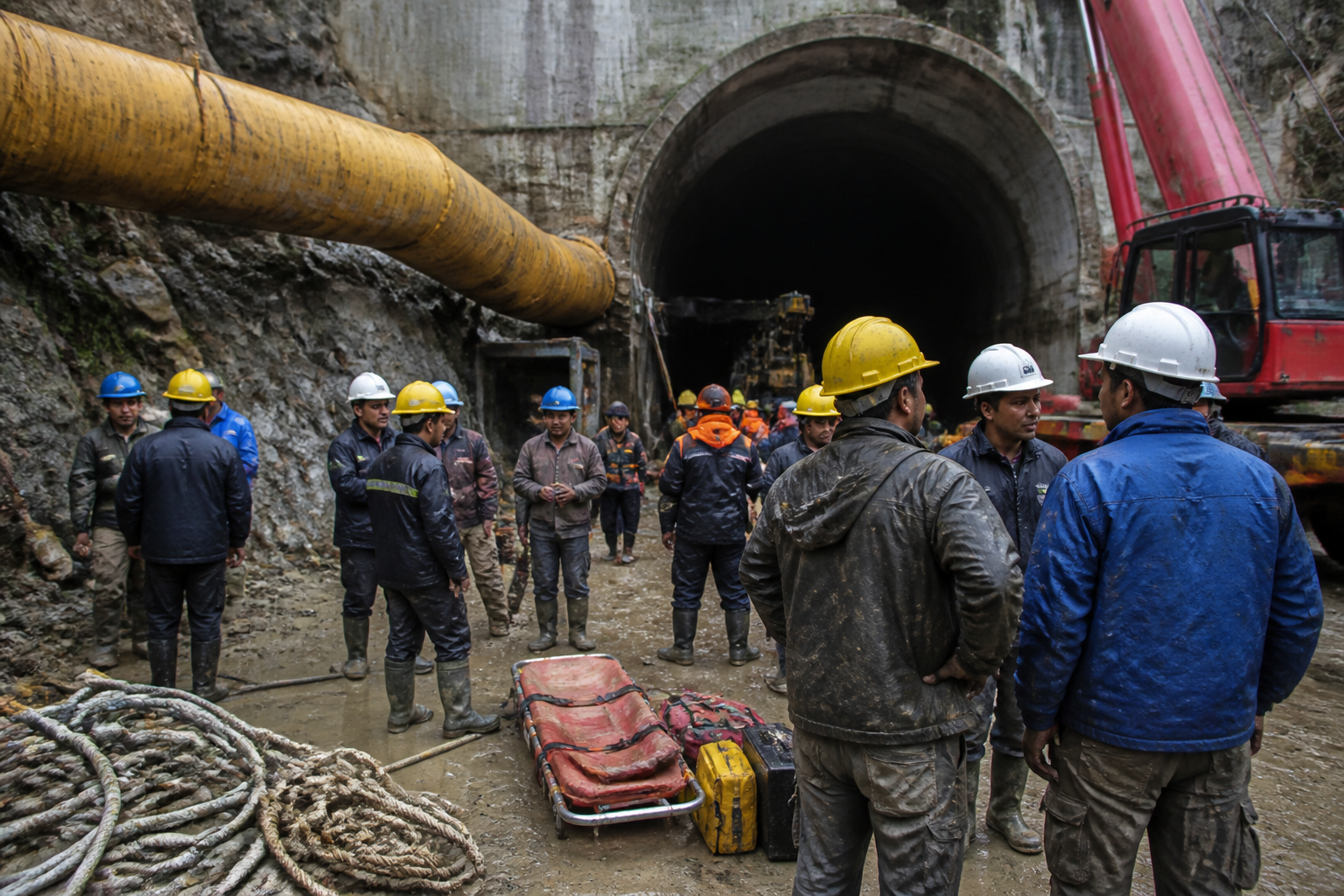
Two hydropower workers have been rescued alive from a tunnel in Nepal nine days after catastrophic flooding and mudslides struck the Trishuli River valley. Their survival has brought a rare moment of relief to a disaster in which more than 1,200 people have died across Nepal and neighbouring areas, while hundreds remain missing.
Sanjay Sah, a mechanical foreman, and Kabir Maharjan, a mechanical supervisor, were recovered on Friday, 4 September 2026, from the Upper Trishuli 3A hydropower project in Rasuwa district. Nepalese authorities said both men were taken for medical treatment in Kathmandu. Reports described Sah as conscious after extraction, while Maharjan required more intensive medical attention.
The rescue was not a straightforward clearing operation. The entrance to the underground complex had been buried, and teams first had to establish where access points remained after the flood carried mud, boulders and structural debris into the project area. Rescue adviser Arnold Dix told the BBC that teams faced an unusually complex sequence of obstacles, including the need to remove exceptionally large rocks from inside the tunnel.
A rescue built around uncertainty
What made the operation especially difficult was the lack of certainty about where workers might be sheltering. The tunnels connected with underground powerhouse and drainage areas, and communications underground were limited. Rescuers had to work through unstable, waterlogged passages while trying to avoid creating further collapses or harming people who might be beyond the debris.
According to reporting from Nepalese authorities and international news agencies, specialist teams from India, China and South Korea were assisting Nepalese Army and other domestic responders at several hydropower sites. The operation at Trishuli 3A involved military and armed-police search teams, engineers and technicians from the Nepal Electricity Authority.
Explosives were reportedly used to break up some of the largest obstructions. That decision carried obvious danger: blasting inside a tunnel can injure trapped people, destabilise surrounding rock or endanger rescuers. The reported use of controlled charges therefore reflects the narrow choices confronting teams rather than a routine technique.
Hope, but not yet a resolution
The recovery of Sah and Maharjan does not establish that other missing workers are alive. Early estimates varied, but officials and industry representatives said large numbers of people may have been inside tunnels connected to hydropower projects along the Trishuli River when the disaster struck. Some assessments referred to roughly 900 missing workers across multiple projects, with several hundred believed to be underground. These figures remain estimates and may change as authorities reconcile worker lists, survivor accounts and recovered bodies.
At Trishuli 3A, rescuers later reported finding one body in addition to the two survivors. Search teams said they had examined accessible sections of the tunnel but did not locate further survivors during that phase. The result underlines the emotional complexity facing families: the rescue has renewed hope, while the evidence from the site also points to the likelihood of further deaths.
The wider disaster began on 26 August, when an extreme flood and associated ice, rock and mud movement devastated settlements and infrastructure in the Himalayan region. Hydropower facilities were particularly vulnerable because workers were operating in enclosed spaces beside rivers and within mountainsides. At least a dozen projects were reported damaged, complicating both rescue logistics and the restoration of electricity and transport links.
The operation also exposes a longstanding challenge for countries developing infrastructure in fragile mountain terrain. Construction capacity may advance faster than emergency planning for complex underground failures. Nepal’s response has drawn on international expertise, but the need to locate buried entrances, move debris safely and maintain breathable conditions illustrates how quickly a major infrastructure project can become a life-support environment.
For the families of Sah and Maharjan, the immediate priority is medical care and reunion. For those still waiting, the operation continues to be measured not in engineering milestones but in the possibility that another worker may still be reached before the remaining spaces become inaccessible.

Leave a Reply