

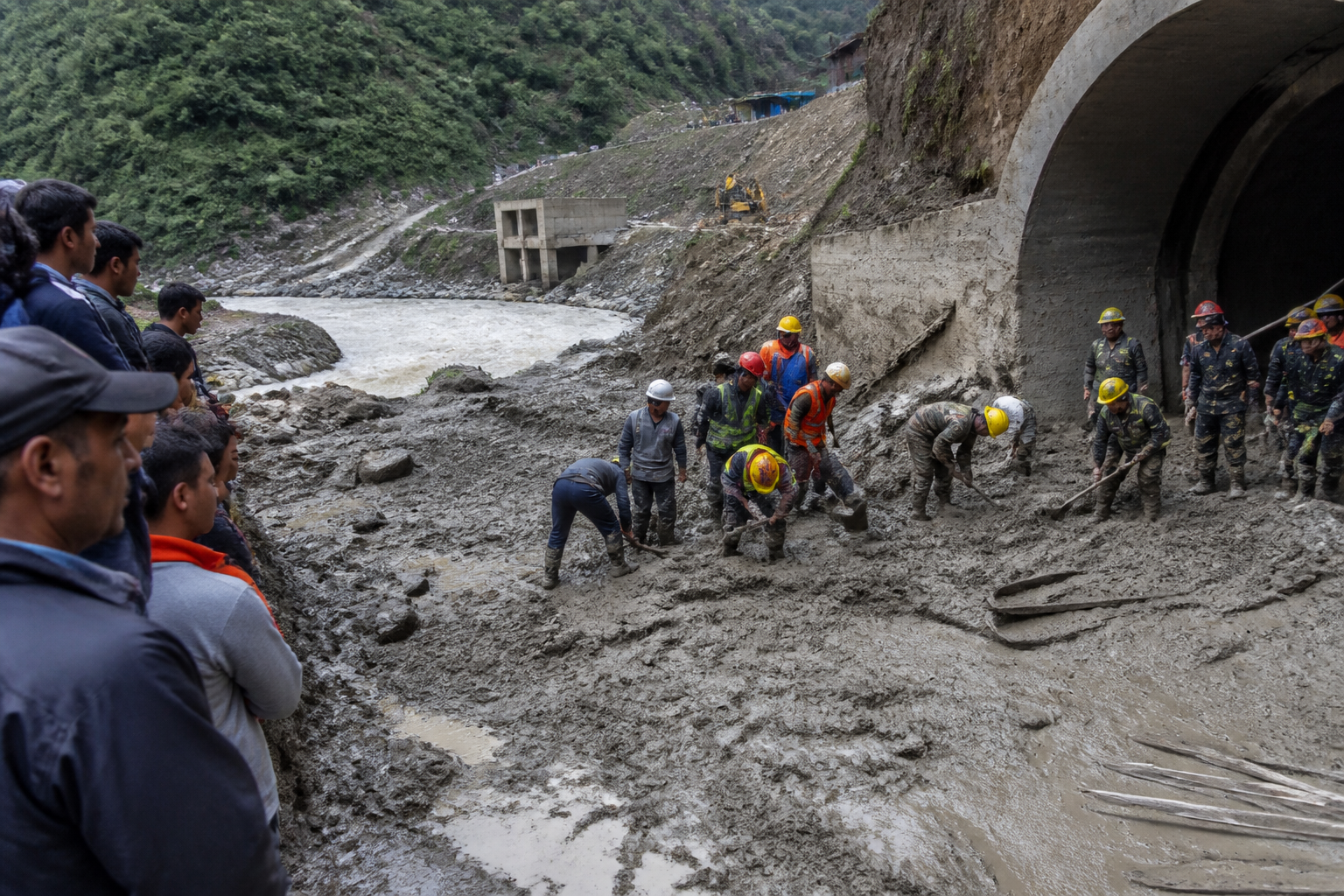
For families gathered around Nepal’s flood-damaged hydropower sites, the rescue of two workers alive from an underground tunnel on Friday, September 4, brought a rare moment of relief amid a disaster still unfolding.
The men were recovered from a tunnel at the Trishuli 3A hydropower project, in the Rasuwa district, nine days after flash floods swept through the Trishuli river corridor. Rescue teams had been clearing mud and debris from the facility when they heard voices from underground, helping them identify where the workers were trapped.
Images released by the Nepal Army showed rescuers carrying one survivor through the damaged site. Both men were flown to Kathmandu for medical treatment. Nepal’s Prime Minister’s Office said one was in critical condition, while officials identified the pair as a mechanical foreman and a mechanical supervisor.
A rescue that changes the calculation
The immediate significance of the breakthrough is human: two people who had been feared lost are alive. Its wider significance is operational. One of the rescued workers reportedly indicated that others may still be inside, and Nepalese officials have continued searching the tunnel rather than treating the recovery as an isolated event.
Authorities say around 900 workers are missing from 12 hydropower projects affected by the flooding, with roughly 500 believed to be trapped in tunnels. At Trishuli 3A alone, about 115 people are believed to remain underground, according to the Independent Power Producers Association of Nepal. Those figures are estimates, not confirmed death counts, and the status of many workers remains unknown.
The uncertainty is especially painful for relatives. Across the flood zone, families have been waiting for news while rescue crews work through unstable entrances, blocked passages and vast quantities of mud. Some communities have been sheltering in schools converted into emergency centres, where food, medicine and information are as urgent as the search itself.
An international operation in difficult terrain
Nepal’s response has involved the army, police, armed police and specialist teams from neighbouring countries. Nepal’s foreign ministry has said that tunnel-rescue personnel from India, China and South Korea are working with Nepali teams at different hydropower sites. Their role reflects the technical difficulty of reaching people in underground facilities damaged by floodwater, landslides and debris.
The disaster began on August 26, when severe flooding struck the Bhote Koshi–Trishuli river system and devastated settlements, roads, bridges and energy infrastructure. Nepalese authorities have said the flooding was likely linked to a glacier collapse, but the precise chain of events remains a matter for assessment. The cause should not be presented as conclusively established until investigations and technical reviews are complete.
The scale of the damage has made rescue a race against time. A tunnel can offer protection from fast-moving water, but it can also become a sealed environment with limited air, water and access. Blocked entrances may prevent rescuers from determining whether people are alive, injured or unreachable. Clearing debris too quickly can also create new risks for workers inside and the teams attempting to enter.
Hope without false reassurance
The two rescues have naturally lifted expectations, but they do not establish that everyone missing underground has survived. Officials continue to use cautious language, distinguishing between people confirmed rescued, people believed trapped and people whose whereabouts remain unknown.
That distinction matters in a disaster where numbers are changing as communications are restored and search teams reach isolated sites. Nepal’s government has created an official flood-rescue portal for missing-person information, emergency contacts and updates, offering families a central channel while operations continue.
The rescue also highlights a longer-term question for Nepal’s rapidly expanding hydropower sector: how emergency planning, worker accountability and tunnel safety are managed when extreme events strike remote construction zones. Those questions require evidence and formal review, not speculation during an active emergency. For now, the priority remains clear—reach the people still missing, support the survivors and give families reliable information.
In a landscape marked by mud, destroyed infrastructure and unanswered calls, the sight of two workers emerging alive has become more than a dramatic rescue. It is a practical reason to continue digging, listening and waiting.


Leave a Reply