

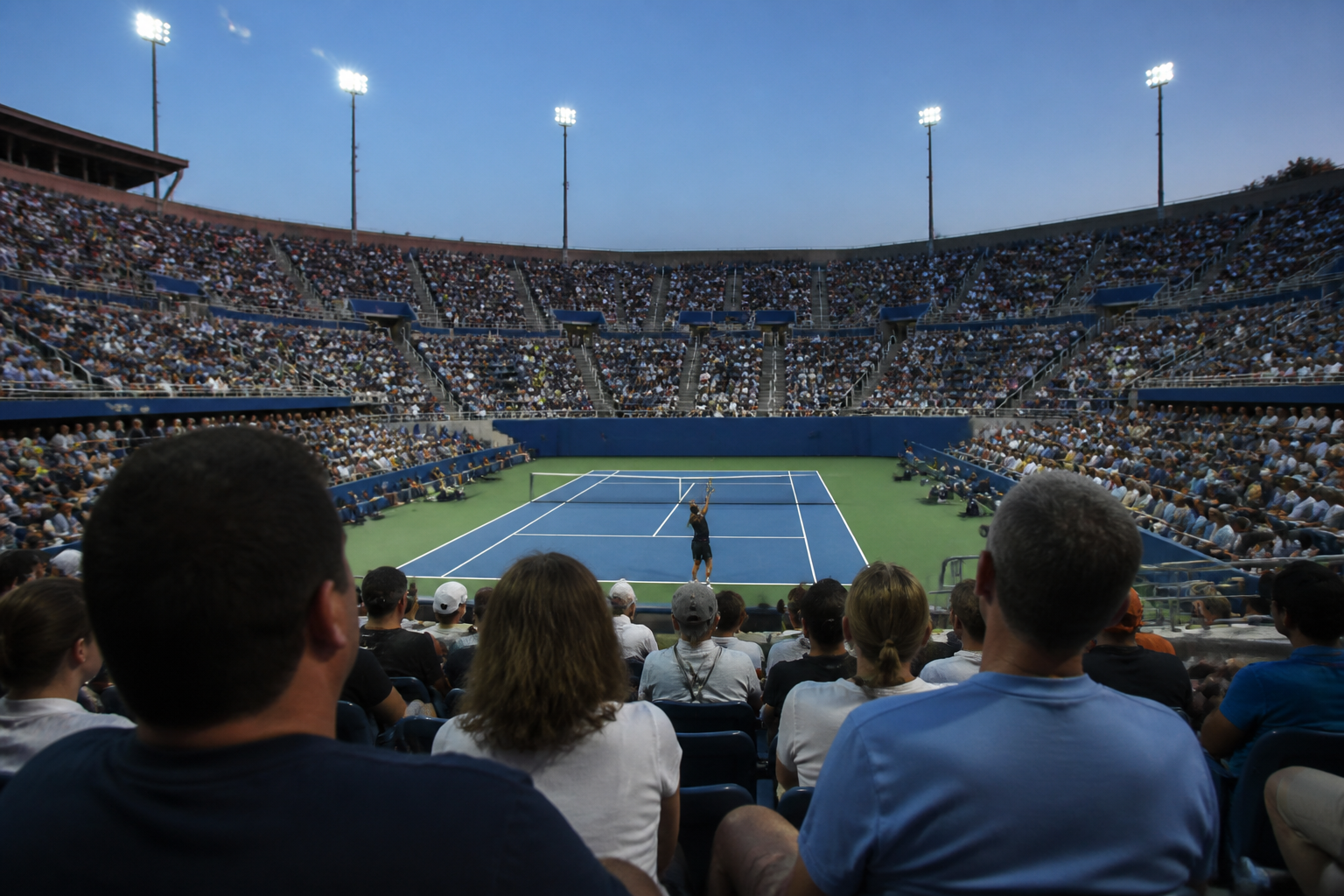
At the 2026 US Open, the argument over influencers is being presented as a question of manners. The deeper issue is access: who is welcomed into a sporting institution, what they are expected to understand when they arrive, and whether the tournament’s drive for reach is keeping pace with its duty to protect the people already inside the stadium.
The controversy intensified during Naomi Osaka’s first-round match against Anastasia Zakharova at Arthur Ashe Stadium. A group of spectators was heard making noise while recording a video during play, prompting chair umpire Kader Nouni to intervene. Another incident involved a bright ring light being used during a match. The moments circulated online and became evidence, for critics, that social-first coverage had crossed into disruption.
Those incidents are confirmed. What is not established is the broader claim that the tournament’s officially credentialed creators caused them. The United States Tennis Association told broadcasters that approximately 100 creators received credentials for this year’s event, but also said the people involved in the Osaka incident were not part of its formal content-creator programme. That distinction matters: an approved media initiative and the behaviour of individual spectators are related to the same public debate, but they are not interchangeable facts.
A deliberate shift in how tennis finds an audience
The creator programme is part of a wider effort to make the US Open more accessible to people who may encounter tennis first through short-form video, personalities, food, fashion or behind-the-scenes coverage rather than through a traditional sports broadcast. The programme began in 2025 with a much smaller group, and the 2026 cohort is understood to be almost twice as large. The tournament has also separately worked with creators to produce content on its behalf.
That strategy reflects a genuine challenge for tennis. Grand Slam events are global spectacles, but the customs of live tennis can be unfamiliar to newcomers. Unlike basketball or many other major American sports, movement, conversation and bright screens can become disruptive at precise moments—especially while a player is serving or a point is underway.
The US Open’s own guidance now makes those expectations explicit. Fans are asked to avoid flash photography and ring lights during match play, keep their voices down during points and avoid leaving their seats when a player is serving if they are within the player’s view. The advice is directed at everyone, not just influencers.
Players are asking for clarity, not exclusion
Public reactions from players have not amounted to a rejection of creators as a group. Coco Gauff has questioned whether brands and organisers should do more to explain etiquette to invited guests, while Jessica Pegula has acknowledged that some creators she follows understand tennis and respect its conventions. Their responses point toward a practical solution: education and enforcement rather than a blanket division between “real fans” and newcomers.
That approach also recognises the people most affected by the debate. Players are working in a high-pressure environment where a pause, sudden light or unexpected noise can interrupt concentration. Long-standing spectators may feel that their experience has been downgraded when attention shifts from the court to the person filming in front of them. New fans, meanwhile, can be treated as intruders for not knowing rules that were never clearly explained.
The responsibility therefore extends beyond individual guests. Brands inviting creators, agencies managing them and tournament officials granting access all have a role in setting boundaries before anyone enters a stand or suite. A credential may provide access, but it does not remove the obligation to behave as part of a shared audience.
The test is whether attention serves the sport
The US Open is right to seek new audiences. Its challenge is to ensure that visibility does not become a substitute for stewardship. Content that helps someone discover tennis can be valuable; content that makes the match itself harder to watch or play is self-defeating.
The immediate answer is straightforward: clear briefings, visible reminders, staff willing to intervene and consistent consequences when conduct crosses the line. The longer-term question is cultural. If tennis wants to become more open, it must teach its traditions without turning them into a gatekeeping device.
The 2026 debate is not proof that creators do not belong at the US Open. It is a test of whether one of the sport’s most recognisable institutions can welcome new participants while preserving the concentration, dignity and shared attention that allow the competition to matter.


Leave a Reply