

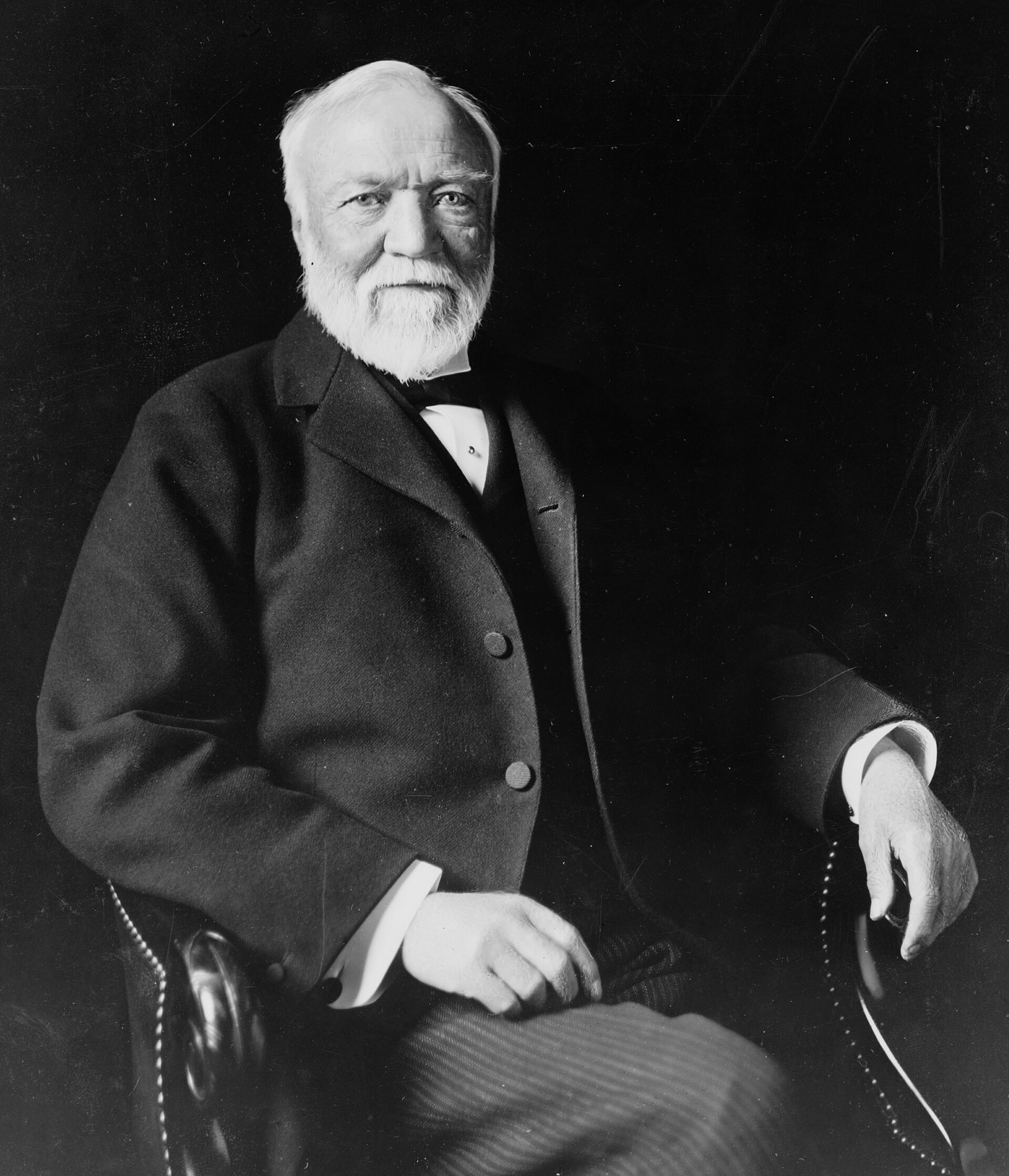
Andrew Carnegie arrived in the United States in 1848, a twelve-year-old immigrant from Dunfermline, Scotland. By the turn of the century, Carnegie Steel had grown into the largest steel manufacturer in the world, producing more than the entire steel industry of Great Britain combined. In 1901, he sold the company to J.P. Morgan for roughly $480 million — a deal that made him, by Morgan's own description, "the richest man in the world."
The Essay That Defined His Second Act
In 1889, more than a decade before that sale, Carnegie had already published "Wealth" — the essay that came to be known as the Gospel of Wealth. In it, he argued that a man who accumulates great wealth carries a duty to use the surplus for public good. His most-quoted line was blunt: "the man who dies rich dies disgraced."
He meant it literally. Over the last eighteen years of his life, Carnegie gave away roughly $350 million — around 90% of his fortune — to charities, foundations and universities. His best-known legacy is architectural as much as philanthropic: he funded 2,500 public libraries across the English-speaking world, beginning in his native Dunfermline.
A Contested Legacy, Still Active Today
Carnegie's record is not without contradiction. The 1892 Homestead Strike, in which his partner Henry Clay Frick violently suppressed a labour dispute at a Carnegie-owned mill, remains a lasting stain on a career otherwise defined by public benevolence. That tension — between how fortunes are built and how they're later spent — is one modern philanthropy still grapples with. The Carnegie Corporation of New York, which he established in 1911, continues to operate today; current president Dame Louise Richardson has said Carnegie's core belief — that wealth carries responsibility — remains the foundation's guiding principle more than a century later.
Key Insights
- Carnegie sold Carnegie Steel to J.P. Morgan for approximately $480 million in 1901.
- His 1889 essay "Wealth" (the Gospel of Wealth) argued the rich have a moral duty to give away their fortunes.
- He gave away roughly $350 million — about 90% of his wealth — funding 2,500 public libraries worldwide.
- His legacy is contested: the 1892 Homestead Strike remains a significant counterpoint to his philanthropic reputation.



Leave a Reply