

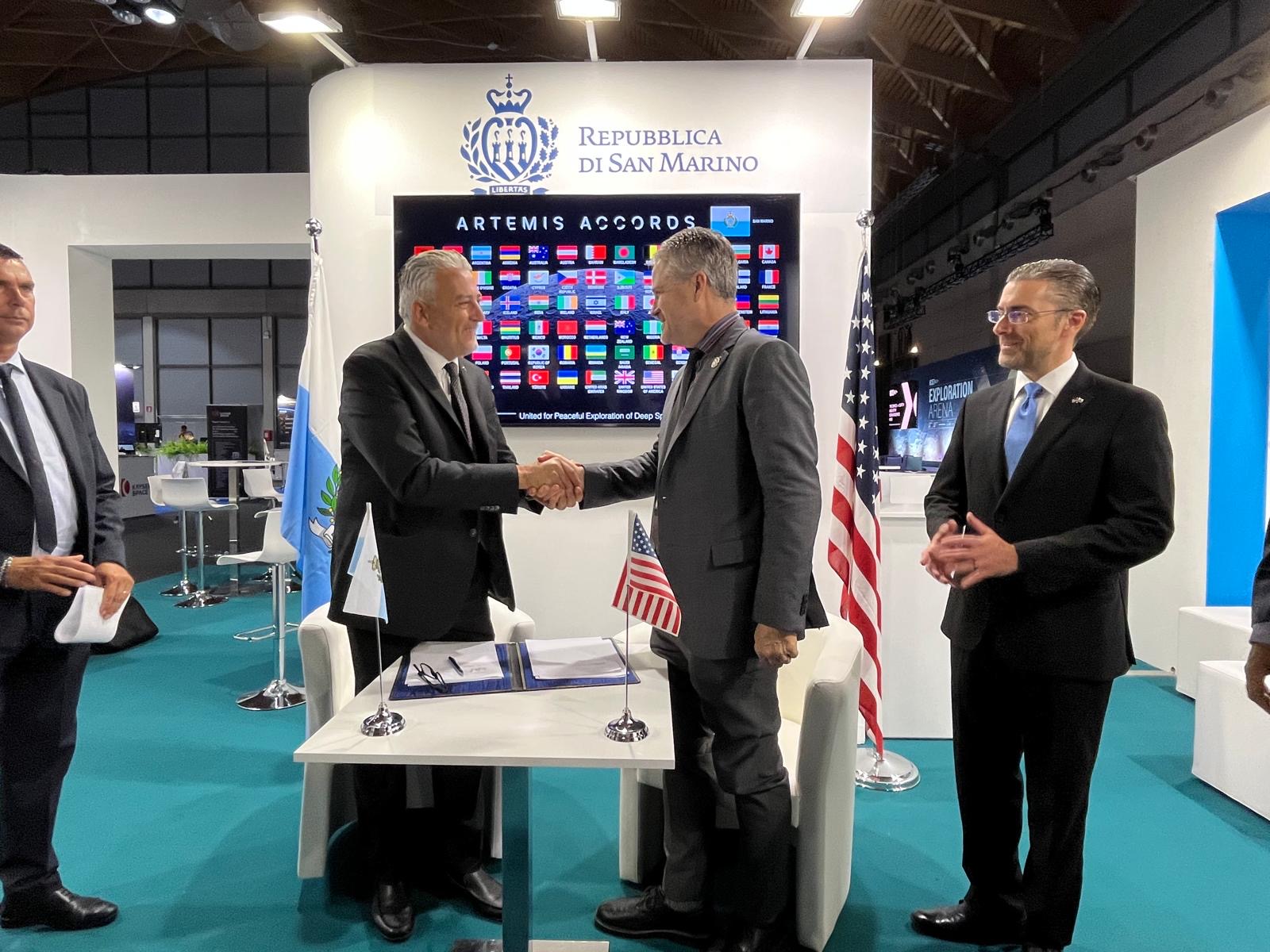
San Marino has become the 76th country to sign the Artemis Accords, the set of principles that guides how nations behave when they explore and use the Moon, Mars and other bodies in space. The signing took place on 25 September 2026 in Rimini, Italy, with NASA and U.S. Department of State officials present.
Rossano Fabbri, San Marino’s Minister of Industry and Technological Research, signed on behalf of the republic. He said San Marino was “pleased and honored” to be welcomed as the 76th signatory, and that the states united under the Accords would help promote international cooperation and the peaceful use of space.
A small state with a seat at the table
San Marino is among the smallest countries in the world, landlocked inside Italy. Its decision shows that the Accords are no longer only a club of major space powers. For a nation with no launch capability, joining is a way to take part in the rules of the road while working with larger partners on science, education and technology.
NASA Deputy Administrator Matt Anderson welcomed the move, saying San Marino “joins a growing coalition of like-minded nations committed to the peaceful, transparent, and responsible exploration of space.”
What the Accords ask of members
The Artemis Accords were established in 2020 by NASA and the U.S. Department of State together with seven founding nations. They are political commitments rather than a treaty. Signatories commit to:
- explore peacefully and transparently;
- help astronauts or spacecraft in distress;
- share scientific data openly;
- avoid interfering with one another’s activities;
- protect sites of historic significance.
Why it matters
Each new member adds weight to a shared set of expectations at a time when more governments and companies are planning missions to the Moon. For smaller states, the framework offers a route into the international space community without needing a space programme of their own.
This report is based on the NASA announcement and the accompanying U.S. mission statement, cross-checked against independent coverage. Figures and quotations are as published on 25 September 2026.



Leave a Reply