

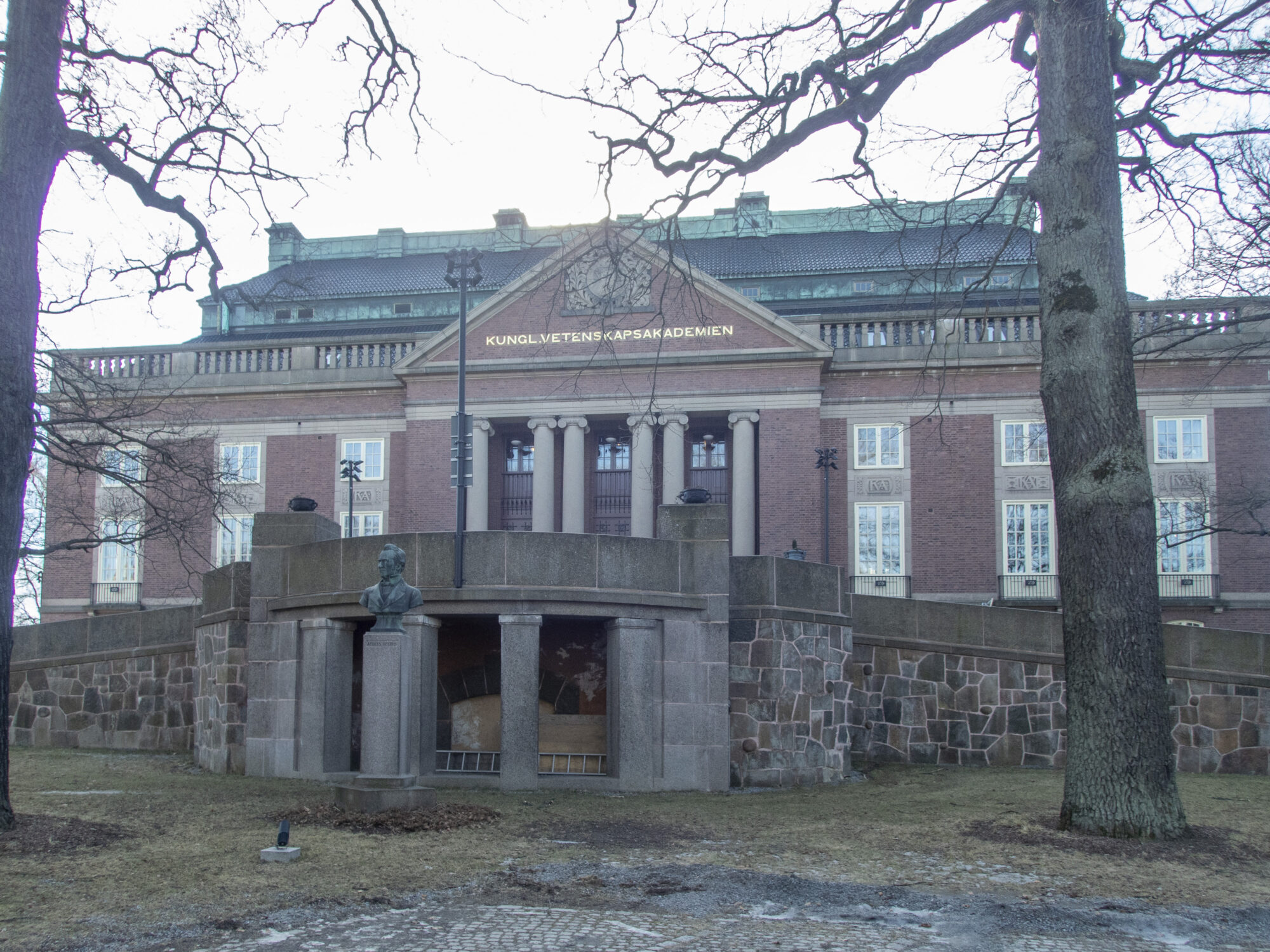
The Royal Swedish Academy of Sciences announced on 7 October 2026 that the Nobel Prize in Chemistry goes jointly to Henri B. Kagan of France and Kenso Soai of Japan “for the discovery of non-linear effects and autocatalysis in asymmetric organic synthesis”. The prize amount is 12 million Swedish kronor, to be shared equally between the two laureates, according to the Academy’s press release.
A Century-Old Puzzle
The Academy explained that some molecules, such as amino acids, exist as two variants that are mirror images of one another, yet living organisms contain only one of them. How such chemical asymmetry, known as homochirality, could emerge was long a mystery to chemists. The Academy said that when chemists began experimenting with reactions that can form two mirrored molecules, they always obtained equal proportions of both. Producing only one mirror image matters, it added, because in molecules designed to interact with living beings, such as pharmaceuticals, only one mirror image has the desired effect.
Heiner Linke, chair of the Nobel Committee for Chemistry, said the two laureates “have provided a solution to a chemical mystery that is over a century old”.
The Two Laureates’ Steps
According to the Academy, Kagan took the first decisive step in 1986, discovering a new way of manipulating chemical reactions that allowed him to create a greater excess of one mirror image than had previously been thought possible. Soai took the next step: a key publication in 1995 described how he designed the first chemical reaction with the potential to be homochiral, and in 2003 he succeeded in presenting a reaction in which only one of the two possible mirror images was formed. The Academy said no one other than life itself had previously achieved this.
Kagan was born in 1930 in Boulogne-Billancourt, France, received his PhD in 1960 from the Collège de France and is Professor Emeritus at the then Université Paris-Sud. Soai was born in 1950 in Hiroshima, Japan, received his PhD in 1979 from the University of Tokyo and is Professor Emeritus at Tokyo University of Science, the Academy said. It added that the discoveries have been decisive for chemists who design reactions for the manufacture of pharmaceuticals.
Why It Matters
The citation recognises work on a basic question about why life’s chemistry has one handedness, and, in the Academy’s account, on tools that chemists now use in designing reactions. It is also a reminder that long-running fundamental questions can take decades, in this case from 1986 to 2003 in the laureates’ own steps, to yield results of practical value.



Leave a Reply