

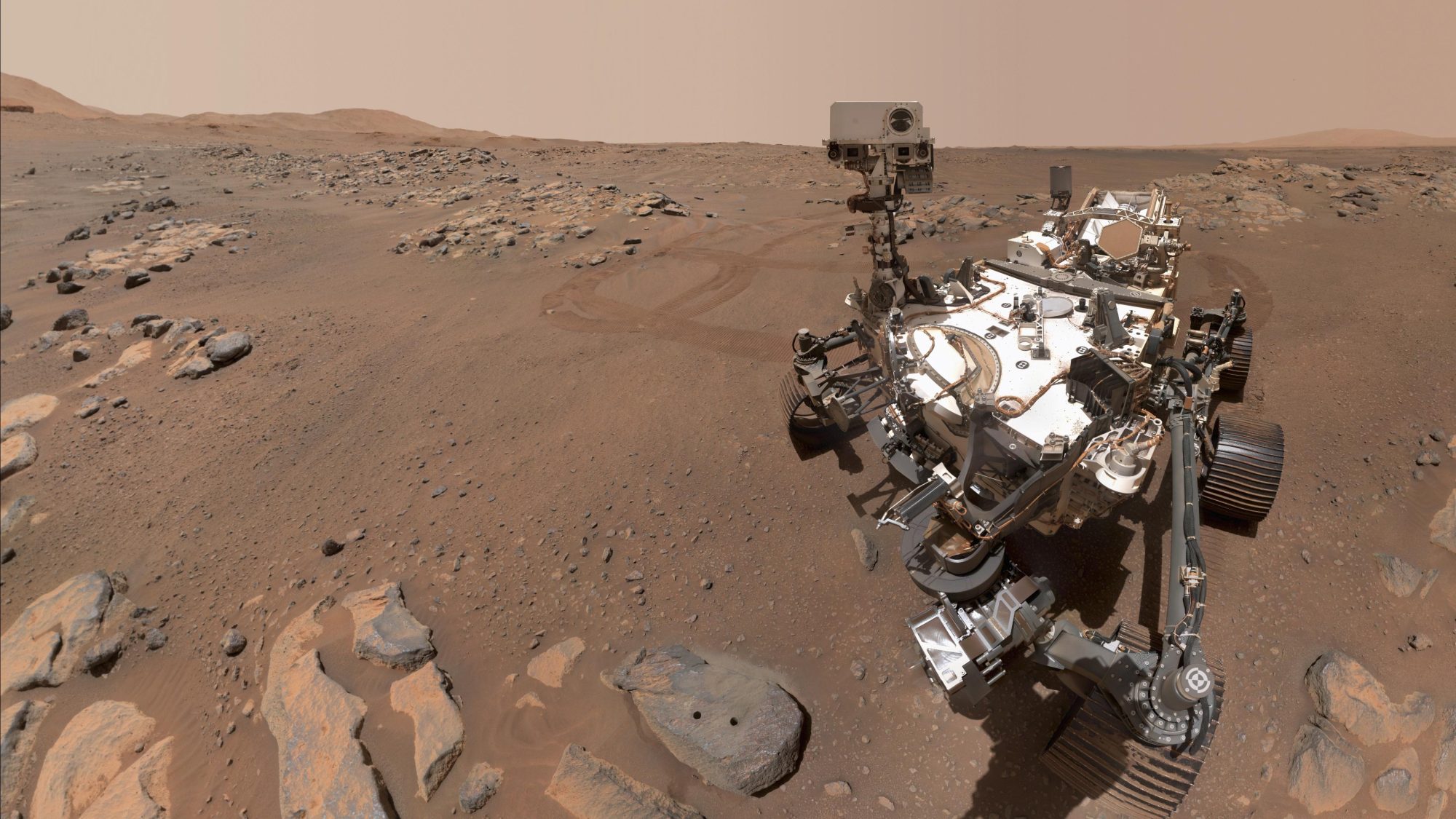
NASA says its Perseverance rover has measured Martian dust far finer than earlier instruments on Mars could resolve, including particles small enough to penetrate the lungs and enter the bloodstream. NASA’s Jet Propulsion Laboratory (JPL) described the findings on 26 October 2026. They come from a study scheduled for publication on 27 October in the journal Proceedings of the National Academy of Sciences (PNAS).
How the dust was measured
NASA says the rover carries five swatches of spacesuit material, each 20 millimetres square, on the calibration target of its SHERLOC instrument, while the calibration target of a second instrument, PIXL, carries Teflon and basaltic glass. Over 1,645 Martian days, dust settling on these surfaces was measured. NASA says earlier measurements on Mars could resolve dust only down to about 3 micrometres. PIXL detected fine particles under 2.5 micrometres and ultrafine particles of around 100 nanometres. A human hair is about 70 micrometres wide, so NASA says the ultrafine particles are about 700 times thinner.
Because Teflon contains no elements that PIXL can directly detect, NASA says the X-ray signals from that sample come from dust resting on it.
What the dust is like
According to NASA, Martian dust grains are rounder and less abrasive than lunar dust, and are enriched in sulfur, chlorine and iron while containing more silica. Static electricity appears to decide which particle sizes stick to which surfaces, and the finest particles stayed attached through years of driving and drilling. NASA says Martian dust is mostly silicate minerals and includes perchlorates, which can disrupt thyroid function, and reactive iron, which can damage cells. It adds that any health risk depends on how much dust a person is exposed to and for how long.
Some materials hold less dust than others, NASA says, which could guide the choice of spacesuit materials, coatings and habitat design. Suitports and dual-chamber airlocks could also keep more dust out of living quarters, it says.
Scott VanBommel, a Perseverance scientist at Washington University in St. Louis and lead author of the paper, said ultrafine dust on Mars has long been predicted, but that the smallest particles are the ones that stay behind and pose the greatest challenge for human support systems. Lindsay Hays, acting director of NASA’s Planetary Science Division, said dust has been a surface-exploration challenge since the Apollo programme, and that the rover is giving engineers and flight surgeons measurements they can use to improve existing designs.
Why It Matters
In our view, the work is a reminder that the practical problems of sending people to Mars include very small ones. The measurements give designers real figures taken on the Martian surface rather than estimates, and NASA says it has also been testing dust-mitigation tools for the Moon. How far the Mars findings change spacesuit and habitat design will depend on further testing, and NASA stresses that the health effects depend on the amount and duration of exposure.



Leave a Reply